AI cardiovascular quantification · Breast arterial calcification

Read the heart in the mammogram she already took.

Avera turns the most routine scan in women's medicine into a quantitative cardiovascular signal. The only model that measures breast arterial calcification in absolute mm², across every major scanner.

123,762 women validated Published, European Heart Journal Built by talented people from Emory University & Mayo Clinic
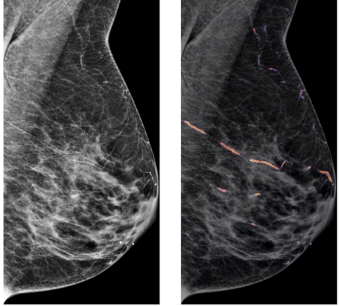
BAC score = 37.61 mm²
Heatmap overlay

Mammogram showing quantified breast arterial calcification — raw view at left, Avera heatmap overlay at right
Automatically detects and quantifies breast arterial calcification from routine screening mammograms as an absolute mm² measurement, analogous to the Agatston score, enabling cardiovascular risk stratification with no additional clinical data required.
Validated on
123,762women · median 7-yr follow-up

Across Emory and Mayo Clinic, five sites, three scanner manufacturers — the largest published BAC quantification cohort.

Severe BAC carries
2.8–3.3×MACE risk vs. no BAC

After adjustment for the AHA PREVENT score. Each additional mm² adds roughly 2% to a woman's major adverse cardiac event risk.

Status
Onlyquantification model on the market

Existing commercial models flag presence or absence. Avera measures severity, in absolute mm² — the cardiovascular equivalent of an Agatston score.

01The problem

A signal in 40 million scans, almost never read.

Cardiovascular disease is the leading killer of women, and the calcification that warns of it has been sitting, unread, on routine mammograms for thirty years.

Breast arterial calcification is visible on every screening mammogram. But it's reported on almost none. The eye is unreliable; the standard is missing.

  • Inter-observer 0.48 – 0.53 correlation between radiologists scoring the same scan by eye.
  • Reporting BAC is rarely surfaced in standard mammography reports; severity grading is absent.
  • Burden CVD kills more women than every cancer combined — yet most miss the warning that's already in their record.
  • Existing tools Detection-only models flag yes/no. None deliver a quantitative, scanner-agnostic score.
02The technology

Quantification, not just detection.

Avera outputs an absolute measurement of calcified arterial area in square millimetres — a continuous severity signal that mirrors the coronary Agatston score clinicians already trust.

A continuous measurement

From yes/no to a score in mm².

The model segments calcified arterial pixels across each view, then integrates total area into a single severity number. Output is reproducible, comparable across visits, and built for trend analysis over a woman's screening history.

0
25+
None · 0 Mild Moderate Severe · > 25 mm²
Vendor-agnostic by design

One model. Three scanner manufacturers.

Validated across Hologic, GE and LORAD systems — the dominant installed base in US imaging centres. The only multi-vendor BAC model in the literature, and the foundation of our advantage over single-vendor incumbents.

Existing models
Avera
Severity in mm²
— detection only
Quantitative
Cohort size (peer-reviewed)
— limited
123,762
Risk-stratification evidence
— presence only
2.8–3.3× MACE
Runs on the scanners you already have
Hologic GE HealthCare
03The evidence

Peer-reviewed. Multi-site. Built on real outcomes.

European Heart Journal · 2024

BAC measured this way predicts major adverse cardiac events — independent of established risk scores.

Developed at Emory and validated across the Mayo Clinic and three additional sites, the Avera model significantly improves cardiovascular risk discrimination on top of the AHA PREVENT score — a clinically meaningful gain in a population that current tools systematically underserve.

5 sites 3 manufacturers Median 7-yr follow-up
Severe BAC (>25 mm²) vs. no BAC Adjusted hazard ratio for MACE
2.8–3.3×
Each additional 1 mm² of BAC Dose–response, per-unit MACE risk
+2%
C-index improvement, internal cohort 0.71 → 0.73 over AHA PREVENT
+0.02
C-index improvement, external cohort 0.62 → 0.64 over AHA PREVENT
+0.02
Women in published validation Largest BAC quantification cohort to date
123,762
04How it works

A score on the report. No new scan.

Avera reads the DICOMs you already capture. The cardiovascular signal arrives alongside the radiologist's mammography read — same workflow, same patient, one additional answer.

i.
Ingest

Routine mammogram comes in.

Standard CC and MLO views, any of the three major scanners. No extra acquisition, no patient prep, no change to the technologist's day.

ii.
Quantify

Avera measures the calcified arterial area, in mm².

The model segments calcifications across views, integrates total area, and emits a continuous severity score — comparable across visits and across scanners.

iii.
Report

The score lands beside the radiology read.

Severity tier and an evidence-anchored note land in the report — ready for the radiologist, the primary-care follow-up, and the cardiology referral when it's warranted.

05Longitudinal signal

A score that moves with her.

Because BAC quantification is a continuous measurement on a routine, repeated scan, Avera turns every screening visit into a data point — and a woman's risk into a trajectory rather than a snapshot.

BAC quantity (mm²) over time · 5 patients
Severe · >25 mm² 0 5 10 15 20 25 30 BAC mm² 0 2 4 6 8 10 Years since baseline
  • Patient 01
  • Patient 02
  • Patient 03
  • Patient 04
  • Patient 05
One patient · 11 years of screening · Avera reads each one
09/29/2009
10/08/2012
10/28/2014
01/23/2018
02/26/2020
06For whom

A quiet upgrade to a scan 40 million women take each year.

Outpatient imaging centres.

Add cardiovascular intelligence to your screening offering. A differentiated patient experience and a new line item, with no new hardware.

Per-inference SaaS
Health systems & ACOs.

Surface high-risk women earlier in the cardiology funnel. Improve risk capture and downstream outcomes across the female population you already see.

Population health
Researchers & registries.

A reproducible, scanner-agnostic BAC score for retrospective cohorts. Build the next decade of women's cardiovascular evidence on a continuous measure.

Research licence
07Questions

What we're often asked.

Q · 01 Is Avera FDA cleared? +
Not yet. Our partner Bunkerhill Health holds a non-exclusive license to the model and is taking it through FDA clearance; we expect to license the cleared version back into the Avera product for commercial use. Today, Avera is offered for investigational and research deployments only, with appropriate institutional approvals.
Q · 02 How is this different from existing BAC tools? +
Other commercial tools detect presence. Avera reports an absolute area in mm² — a continuous severity score, comparable visit-to-visit and across scanner manufacturers. It is the only model in the literature validated on Hologic, GE and LORAD.
Q · 03 What does deployment actually look like? +
We integrate at the DICOM level — the model reads the mammograms already flowing through your PACS and writes a structured score back into the radiology workflow. No new acquisitions, no patient re-call, no change to the technologist's process.
Q · 04 How is the score used clinically? +
The BAC score is an adjunctive signal — it supports, but does not replace, the radiologist's read and the patient's primary clinician. Severe scores typically prompt cardiology referral and consideration of preventive intervention; mild scores join the longitudinal record.
Q · 05 What's the pricing model? +
A per-inference SaaS price, with volume terms for health-system deployments and bespoke arrangements for research cohorts. Reach out for a pilot quote against your annual screening volume.

A cardiovascular signal
in every mammogram.

We're partnering with imaging networks, health systems and women's-health researchers ahead of broader availability. Tell us about your population and we'll come back with a pilot proposal.